
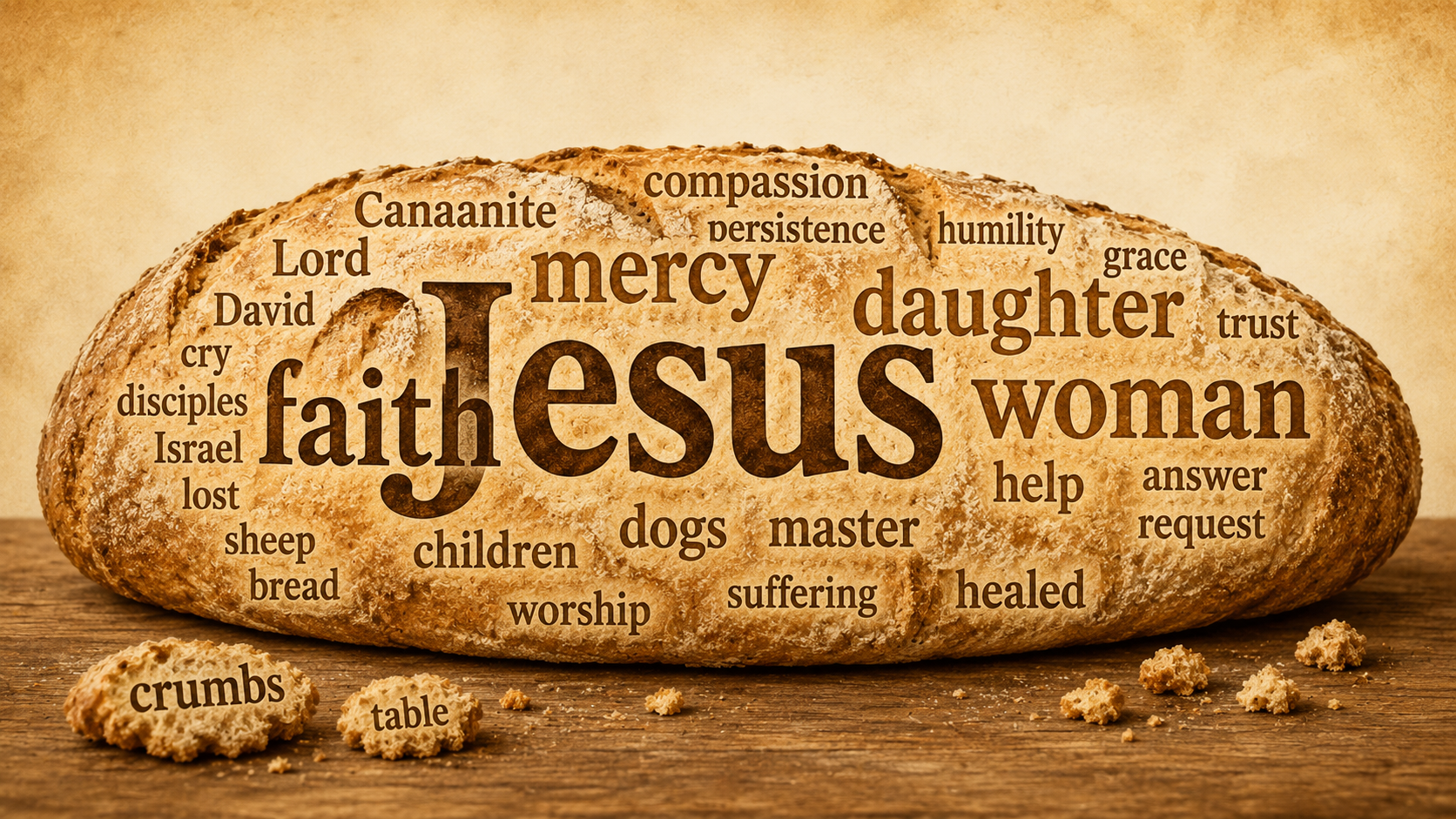
Matthew 15:21–28 tells the story of a mother who refuses to let social boundaries, religious prejudice, or even silence keep her from bringing her daughter to Jesus. She is identified as a Canaanite woman, an outsider whose ethnicity, religion, and gender would have placed her far beyond the ordinary boundaries of Jewish religious life. Yet she recognizes something in Jesus that many religious leaders have missed. She calls Him “Lord” and “Son of David,” trusting that He carries the authority and mercy of Israel’s Messiah.
The encounter is difficult because Jesus doesn’t answer her immediately. When He does speak, His words appear to reinforce the boundary between Israel and the Gentile world. Yet the woman doesn’t turn away. She takes the image Jesus gives her and finds room within it for grace. She doesn’t demand a privileged place. She simply trusts that even the smallest portion of Christ’s mercy is enough to change her daughter’s life.
Jesus responds, “Woman, you have great faith! Your request is granted.” Her daughter is healed at that moment. The woman who began as an unnamed outsider becomes an example of remarkable faith. This passage reminds us that God’s grace reaches beyond the boundaries people create, and that persistent faith continues to trust even when God seems silent.
Origin and Name
The Gospel takes its name from Matthew, also known as Levi, a tax collector
who became one of Jesus’ twelve disciples. That matters because Matthew’s own
calling reflects one of the Gospel’s central convictions: Jesus brings grace to
people others have written off. A tax collector becoming a disciple and witness
fits the larger story of a Messiah who calls sinners, heals outsiders, and
forms a new people by mercy (France).
Authorship
Early Christian tradition connects this Gospel with Matthew the apostle. The
Gospel itself does not name its author, but it shows deep knowledge of Jewish
Scripture, careful theological structure, and concern for the life and teaching
of the Church. It presents Jesus as the fulfillment of Israel’s story and the
authoritative teacher of God’s people (Keener).
Date and Setting
Matthew was likely written between AD 70 and 90, after the destruction of
the Jerusalem temple. Jewish and Christian communities were wrestling with
identity, authority, worship, and faithfulness in a changed world. Matthew
speaks into that setting by showing that Jesus is not a break from God’s
promises to Israel but their fulfillment (Davies and Allison).
Purpose and Themes
Matthew presents Jesus as Messiah, Son of David, Son of Abraham, Son of God,
and Immanuel. Major themes include fulfillment of Scripture, the kingdom of
heaven, righteousness shaped by mercy, discipleship, judgment, mission, and the
presence of Christ with His people. Matthew never separates grace from
obedience. Jesus calls people into mercy, forgiveness, transformation, and
faithful living.
Structure
Matthew weaves narrative and teaching together. The Gospel includes five
major teaching sections, often seen as echoing the five books of Moses. Jesus
appears as the greater teacher who fulfills and rightly interprets God’s will.
The Gospel moves from Jesus’ birth and identity, through His ministry and
teaching, into His suffering, death, resurrection, and final commissioning of
the disciples.
Significance
Matthew bridges the story of Israel and the mission of the Church. It shows
that God’s covenant promises continue through Jesus and now move outward to all
nations. The final scene in Matthew 28 does not close the story as much as it
opens the Church’s mission.
Matthew 15:21–28 follows Jesus’ dispute with the Pharisees and teachers of the law concerning purity. They criticize the disciples for eating without performing traditional ceremonial washing. Jesus responds that true defilement doesn’t come from what enters the mouth but from what comes out of the heart.
Immediately after teaching about what is truly clean and unclean, Jesus encounters a Gentile woman who would have been considered religiously and socially unclean. The placement is intentional. The religious leaders appear outwardly respectable, but their hearts resist Jesus. The Canaanite woman is an outsider, yet her heart is filled with faith, humility, courage, and love for her daughter (France).
Matthew’s use of the word “Canaanite” is striking. By the first century, this was an ancient designation rather than the ordinary name for people living in that region. The term recalls Israel’s historic enemies and emphasizes how far outside the covenant community this woman appears to stand (Davies and Allison). Matthew wants readers to feel the distance between her and Jesus before showing how grace crosses that distance.
This encounter also points toward the Gospel’s conclusion. Jesus’ earthly ministry is directed primarily toward Israel, but His mission will expand. After His resurrection, He sends His disciples to make disciples of all nations. The healing of this woman’s daughter is a sign that the mercy promised through Israel’s Messiah will eventually reach the whole world.
Within the wider biblical story, this fulfills God’s promise to Abraham that all nations would be blessed through his family. Israel was chosen not so that grace could be kept within one group, but so that God’s blessing could reach every family of the earth.
John Wesley would have recognized prevenient grace at work in the Canaanite woman. Before she receives healing, before she fully understands Jesus’ mission, and before the disciples welcome her, God’s grace is already drawing her toward Christ.
Prevenient grace is the grace that comes before conscious faith. It awakens the heart, creates spiritual hunger, and enables a person to respond to God. The woman’s persistence isn’t simply stubbornness. Her faith is evidence that grace has already been working within her.
Wesley emphasized that Christ died for all people and that God’s grace is offered freely to all. No person, nation, culture, or social class exists beyond the reach of God’s saving love. This doesn’t mean every person automatically accepts salvation, but it does mean that grace is genuinely extended to everyone (Collins).
The woman’s faith also demonstrates humility. She doesn’t claim that she deserves healing. She trusts Jesus’ character. Her response shows that faith isn’t confidence in our worthiness but confidence in Christ’s mercy.
The disciples want her sent away, but Jesus receives her, commends her faith, and answers her prayer. This challenges the Church to examine whether we’re helping people come to Christ or trying to silence those who don’t fit our expectations. Holiness isn’t separation from people whom God loves. Holiness is perfect love for God and neighbor, shaped by the grace of Jesus Christ.
Matthew 15:21–22, A Cry from Beyond the Boundary
Jesus withdraws to the region of Tyre and Sidon, a predominantly Gentile area northwest of Galilee. A Canaanite woman approaches Him and cries, “Lord, Son of David, have mercy on me! My daughter is demon-possessed and suffering terribly.”
Her words are remarkable. “Son of David” is a Jewish messianic title. Although she stands outside Israel’s covenant community, she recognizes Jesus as Israel’s promised King. The religious leaders who know the Scriptures resist Jesus, while this foreign woman sees Him more clearly.
Her prayer begins with mercy. She doesn’t attempt to bargain with Jesus or prove her worth. She brings her daughter’s suffering before Him and appeals to His compassion. Her daughter’s pain has become her own, so she cries, “Have mercy on me.”
The woman models intercessory prayer. She comes to Jesus on behalf of someone who may be unable to come for herself. Love carries another person’s suffering into the presence of Christ.
Matthew 15:23, The Silence of Jesus
Jesus initially gives her no answer. His silence is one of the hardest parts of the passage. Matthew doesn’t explain what the woman feels or how long the silence lasts. We only know that she keeps crying out.
The silence of God is a common biblical experience. The Psalms repeatedly ask how long God will remain silent. Faith doesn’t always receive an immediate answer, and silence doesn’t necessarily mean rejection.
The disciples become irritated and say, “Send her away, for she keeps crying out after us.” Their words may mean they want Jesus to dismiss her or grant her request so she’ll leave. Either way, they view her primarily as a disturbance rather than as a suffering mother.
This reflects how easily religious communities can become more concerned with preserving comfort than responding to pain. The disciples hear noise. Jesus sees faith.
Matthew 15:24, The Lost Sheep of Israel
Jesus says, “I was sent only to the lost sheep of Israel.” His statement reflects the historical order of His earthly mission. God’s covenant promises were given through Israel, and Jesus came as Israel’s Messiah. His ministry first called Israel to repentance, restoration, and renewed faithfulness.
This priority doesn’t mean God has no concern for Gentiles. Matthew has already included Gentiles within the story of Jesus. The Magi worship Him, and Jesus heals the servant of a Roman centurion. Jesus’ ministry begins with Israel, but it won’t end there (Keener).
God’s promise to Israel has always carried a wider purpose. Through Abraham’s descendants, all nations were to be blessed. Israel’s Messiah would become the hope of the world.
Matthew 15:25–26, A Difficult Saying
The woman comes closer, kneels before Jesus, and says, “Lord, help me!” Her prayer becomes shorter and more urgent. She has no theological argument left to make. She simply asks for help.
Jesus responds, “It is not right to take the children’s bread and toss it to the dogs.” The statement sounds harsh to modern readers, and it shouldn’t be treated casually. In Jewish speech, Gentiles were sometimes compared to dogs, which were generally viewed as unclean animals.
The Greek word used here can refer to small household dogs rather than wild scavengers. This softens the picture slightly, but it doesn’t erase the distinction. The children represent Israel, the bread represents the blessings of the Messiah, and the dogs represent those outside Israel’s covenant community (France).
Jesus’ words place the apparent barrier directly before the woman. Matthew doesn’t tell us whether His purpose is to test her faith, reveal the disciples’ prejudice, demonstrate the historical priority of Israel, or some combination of these. The narrative invites readers to remain within the tension.
Matthew 15:27, Faith Finds Grace
The woman answers, “Yes it is, Lord. Even the dogs eat the crumbs that fall from their master’s table.”
She doesn’t argue that Israel should lose its place. She sees that there is enough mercy at Jesus’ table for others too. She accepts the image and finds hope within it. If God’s grace is as abundant as she believes, then even what falls from the table is enough to bring healing.
Her answer isn’t passive submission to humiliation. It’s a bold confession of faith. She trusts that Jesus’ mercy can’t be exhausted. She believes that Israel’s blessing is so abundant that it will overflow to outsiders.
The woman doesn’t ask Jesus to love Israel less. She trusts that His love is large enough to include her daughter too.
Matthew 15:28, Great Faith and Immediate Healing
Jesus answers, “Woman, you have great faith! Your request is granted.” Her daughter is healed at that moment.
Jesus publicly praises the faith of someone the disciples wanted to send away. Her ethnicity, gender, religious background, and social standing don’t prevent her from receiving mercy. Faith opens her life to the grace already reaching toward her.
The daughter is healed from a distance. Jesus doesn’t need to enter the home, touch the child, or perform a visible ritual. His authority isn’t limited by geography. His word is enough.
The woman’s persistence doesn’t force an unwilling Jesus to become merciful. Instead, her persistence reveals the depth of her trust in the mercy already present in Him. She believes Jesus is better, kinder, and more gracious than the boundaries surrounding her suggest.
This passage is sometimes used to argue that Jesus was prejudiced or that the woman had to correct Him. The difficulty of Jesus’ language shouldn’t be dismissed. Scripture is honest enough to preserve an encounter that creates discomfort and demands careful interpretation.
The larger Gospel, however, doesn’t present Jesus as hostile toward Gentiles. Gentiles appear in His genealogy, worship Him after His birth, receive healing during His ministry, and are included in the final mission of the Church. Jesus’ statement reflects the covenantal order of His mission, not the permanent exclusion of other nations.
The woman’s response reveals the direction of the story. God’s promises to Israel will overflow to the world. Jesus doesn’t reject her faith. He praises it and grants her request.
The passage also offers evidence of authenticity. The early Church would’ve had little reason to invent a story in which the disciples appear impatient and a foreign woman displays greater faith than those closest to Jesus. The account challenges the pride of insiders and elevates the faith of an outsider.
Christian faith doesn’t claim that people earn grace through ethnicity, religious heritage, or moral achievement. Salvation rests in the mercy of God revealed in Jesus Christ. The Canaanite woman receives healing because she trusts Christ, not because she proves herself worthy.
Many people know what it feels like to approach God from the outside. They may believe their past, questions, failures, family background, or lack of religious knowledge disqualifies them. This woman reminds us that no honest cry for mercy is beneath the attention of Jesus.
There are also seasons when prayer seems to meet silence. We pray for healing, reconciliation, deliverance, or guidance, but nothing appears to change. The woman teaches us to remain near Jesus. Faith doesn’t deny the pain of silence. Faith continues to trust the character of Christ while waiting for an answer.
Her story speaks especially to parents and caregivers who carry the suffering of someone they love. Sometimes all we can pray is, “Lord, help me.” That prayer is enough. God doesn’t require polished language before He listens.
The disciples challenge the Church to examine its own behavior. We may welcome people in theory while becoming uncomfortable when their needs interrupt our routines. We may prefer people who speak our language, understand our customs, or behave in familiar ways. Yet Jesus repeatedly draws attention to the people others attempt to send away.
The Church must never guard the table of grace as though mercy were scarce. There is enough grace in Jesus for every person who comes to Him. We don’t have to push one group away to make room for another. Christ’s love isn’t divided when it is shared.
The Canaanite woman believed that even a crumb of Christ’s mercy could change everything. We know more than she knew that day. Through the cross and resurrection, Jesus has opened the way of salvation to people from every nation. We aren’t invited to settle for crumbs. Through faith in Christ, we’re welcomed into the household of God.
Genesis
12:1–3
Isaiah 49:5–6
Matthew 8:5–13
Mark 7:24–30
Luke 18:1–8
Romans 10:11–13
Galatians 3:26–29
Ephesians 2:11–22
Hebrews 4:14–16
