
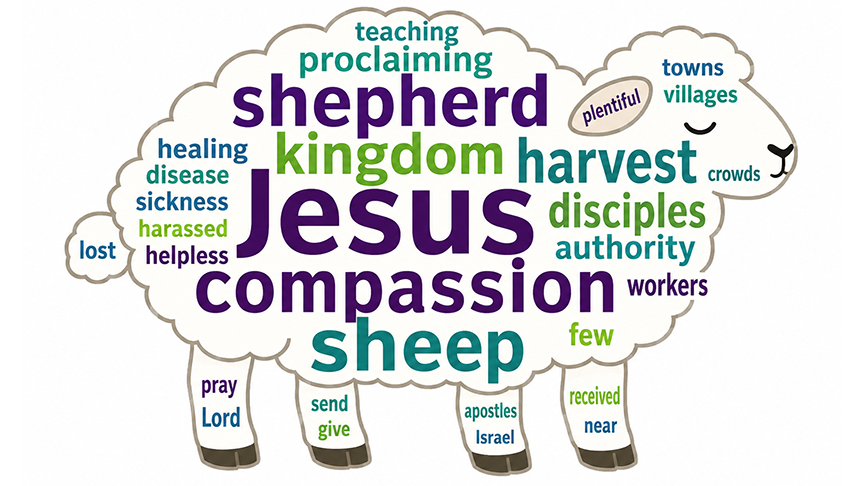
Matthew 9:35–10:8 speaks into moments when people are worn down, scattered, and unsure who will care for them. Jesus has been moving through towns and villages, teaching, proclaiming the kingdom, and healing every disease and sickness. He has met the blind, the paralyzed, the grieving, the outcast, the religiously confused, and the spiritually hungry. Then Matthew tells us what Jesus sees beneath all of it. He sees people “harassed and helpless, like sheep without a shepherd.”
That phrase carries deep compassion. Jesus does not look at hurting people with irritation or distance. He does not blame them for their exhaustion. He sees their suffering, their confusion, and their need for faithful care. The people are not a problem to be managed. They are beloved children of God who need shepherding, healing, truth, and mercy (France).
Jesus then turns to His disciples and says, “The harvest is plentiful but the workers are few.” The image changes from sheep to harvest, but the point remains the same. There is great need, and there is great opportunity. God is already at work, but the people who will carry the work forward are few. So Jesus tells the disciples to pray to the Lord of the harvest to send out workers. Then, almost immediately, He sends them.
That movement matters. The disciples pray, and then they become part of the answer to the prayer. Jesus gives them authority, names them, and sends them with a clear mission. They are not sent because they are impressive. They are sent because Jesus is compassionate, and His mission is rooted in grace (Keener).
Origin and Name
The Gospel takes its name from Matthew, also known as Levi, a tax collector
who became one of Jesus’ twelve disciples. That matters because Matthew’s own
calling reflects one of the Gospel’s central convictions: Jesus brings grace to
people others have written off. A tax collector becoming a disciple and witness
fits the larger story of a Messiah who calls sinners, heals outsiders, and
forms a new people by mercy (France).
Authorship
Early Christian tradition connects this Gospel with Matthew the apostle. The
Gospel itself does not name its author, but it shows deep knowledge of Jewish
Scripture, careful theological structure, and concern for the life and teaching
of the Church. It presents Jesus as the fulfillment of Israel’s story and the
authoritative teacher of God’s people (Keener).
Date and Setting
Matthew was likely written between AD 70 and 90, after the destruction of
the Jerusalem temple. Jewish and Christian communities were wrestling with
identity, authority, worship, and faithfulness in a changed world. Matthew
speaks into that setting by showing that Jesus is not a break from God’s
promises to Israel but their fulfillment (Davies and Allison).
Purpose and Themes
Matthew presents Jesus as Messiah, Son of David, Son of Abraham, Son of God,
and Immanuel. Major themes include fulfillment of Scripture, the kingdom of
heaven, righteousness shaped by mercy, discipleship, judgment, mission, and the
presence of Christ with His people. Matthew never separates grace from
obedience. Jesus calls people into mercy, forgiveness, transformation, and
faithful living.
Structure
Matthew weaves narrative and teaching together. The Gospel includes five
major teaching sections, often seen as echoing the five books of Moses. Jesus
appears as the greater teacher who fulfills and rightly interprets God’s will.
The Gospel moves from Jesus’ birth and identity, through His ministry and
teaching, into His suffering, death, resurrection, and final commissioning of
the disciples.
Significance
Matthew bridges the story of Israel and the mission of the Church. It shows
that God’s covenant promises continue through Jesus and now move outward to all
nations. The final scene in Matthew 28 does not close the story as much as it
opens the Church’s mission.
Matthew 9:35–10:8 comes at a turning point. Matthew 4:23 said that Jesus went throughout Galilee teaching, proclaiming, and healing. Matthew 9:35 repeats that same pattern, bringing this section of Jesus’ ministry to a close. What Jesus has been doing, He now begins to share with His disciples.
The passage also prepares for Matthew 10, where Jesus gives instructions for mission. The disciples will proclaim the kingdom, heal the sick, raise the dead, cleanse those with leprosy, and drive out demons. Their work is not separate from Jesus’ work. It flows from Him.
Within the wider biblical story, the image of sheep without a shepherd echoes Old Testament concerns about failed leaders. God’s people had often suffered because those who were supposed to guide them neglected justice, mercy, and faithfulness. Jesus steps into that failure as the true Shepherd, and then He sends His disciples to participate in His care for the people (Wright).
This passage also points forward to the mission of the Church. In Matthew 10, the mission begins with “the lost sheep of Israel.” By Matthew 28, that mission expands to all nations. God’s covenant promises move in order, but they do not stay narrow. Grace begins with Israel and overflows to the world.
John Wesley would have heard prevenient grace in this passage. Jesus sees the crowds before they ask for help. He feels compassion before they understand the fullness of their need. Grace is already moving toward them. God’s love is not waiting at a distance until people become worthy. God comes near first.
Wesley would also have recognized the connection between prayer and action. Jesus tells the disciples to pray for workers, and then He sends them as workers. Prayer does not remove us from responsibility. Prayer opens us to God’s heart and prepares us to join God’s work (Collins).
This passage also reflects Wesley’s concern for practical holiness. The disciples are not sent only to preach words. They are sent to heal, restore, cleanse, and set people free. For Wesley, holiness was never private religion alone. Love of God and love of neighbor belonged together. The gospel touches souls, bodies, families, communities, and systems of suffering.
The phrase “Freely you have received; freely give” fits deeply with Wesleyan theology. Grace is gift before it is task. The disciples do not own the kingdom message. They have received mercy, authority, healing, and calling from Jesus. Now they are to give without pride, manipulation, or greed. Ministry is not possession. It is stewardship.
Matthew 9:35, The Pattern of Jesus’ Ministry
Jesus goes through towns and villages, teaching in synagogues, proclaiming the good news of the kingdom, and healing every disease and sickness. This verse gives a clear summary of Jesus’ work. His ministry is not one-dimensional. He teaches truth, announces God’s reign, and restores broken lives.
The kingdom of heaven is not only talked about. It is seen in mercy, healing, deliverance, forgiveness, and renewed community. Jesus’ words and actions belong together (France).
Matthew 9:36, Compassion for the Harassed and Helpless
When Jesus sees the crowds, He has compassion on them. The word points to deep, gut-level mercy. Jesus is moved from the center of who He is. He sees people as “harassed and helpless,” like sheep without a shepherd.
This is not sentimental pity. It is holy compassion that leads to action. Jesus sees the spiritual condition of the people. They are tired, pressured, vulnerable, and poorly led. The religious leaders have not shepherded them with the heart of God. Jesus does.
Matthew 9:37–38, The Harvest and the Workers
Jesus tells His disciples, “The harvest is plentiful but the workers are few.” The need is large, but the problem is not that God is absent. The harvest belongs to God. The field belongs to God. The mission belongs to God.
The disciples are told to ask the Lord of the harvest to send workers. Before they are sent, they are taught to pray. This keeps mission from becoming self-reliant. The Church does not create the harvest. The Church joins the work of the Lord who owns the harvest (Keener).
Matthew 10:1, Authority Given to the Disciples
Jesus calls His twelve disciples and gives them authority to drive out impure spirits and heal disease and sickness. The authority is not theirs by nature. It is given by Jesus.
This is important. The disciples do not act as independent religious heroes. They act under the authority of Christ. Their ministry depends on His power, His compassion, and His command. The Church’s mission still works this way. We serve best when we remember that the authority, message, and mercy all come from Jesus.
Matthew 10:2–4, The Naming of the Twelve
Matthew names the twelve apostles: Simon Peter, Andrew, James, John, Philip, Bartholomew, Thomas, Matthew the tax collector, James son of Alphaeus, Thaddaeus, Simon the Zealot, and Judas Iscariot.
The list is honest and human. There are fishermen, a tax collector, a zealot, and the one who will betray Jesus. This is not a polished group of religious professionals. These are ordinary, complicated people called into extraordinary service.
Matthew even identifies himself as “the tax collector.” He does not hide the past from which Jesus called him. Grace does not erase the truth. Grace redeems it (Davies and Allison).
Matthew 10:5–6, A Mission That Begins with Israel
Jesus sends the Twelve first to “the lost sheep of Israel.” This does not mean God does not love Gentiles or Samaritans. Matthew has already shown Gentile inclusion in the genealogy, the visit of the Magi, and Jesus’ ministry in Galilee. The mission begins with Israel because God’s covenant promises are being fulfilled in order (France).
The lost sheep language connects back to Matthew 9:36. Jesus’ compassion for the crowds now becomes the disciples’ assignment. They are sent to the people who should have been shepherded well but were not.
Matthew 10:7, The Message of the Kingdom
The disciples are told to proclaim, “The kingdom of heaven has come near.” This is the same message Jesus preached. They are not sent to invent a message. They are sent to carry His.
The kingdom has come near because the King has come near. In Jesus, God’s reign is present, active, merciful, and powerful. The message calls people to turn, trust, receive, and live under God’s gracious rule.
Matthew 10:8, Freely Received, Freely Given
Jesus tells the disciples to heal the sick, raise the dead, cleanse those with leprosy, and drive out demons. These signs show the restoring power of God’s kingdom. The gospel is good news for the whole person.
Then Jesus says, “Freely you have received; freely give.” This guards the disciples from turning ministry into a transaction. They have not earned their calling. They have received grace. So they must give with open hands.
This verse is a needed word for the Church. We do not sell mercy. We do not hoard grace. We do not serve to prove our worth. We serve because Christ has first served us.
This passage gives a strong answer to the idea that Christianity is only a private feeling or vague spirituality. Matthew roots the mission of Jesus in real places, named people, public action, and visible need. The Twelve are named, including flawed and complicated disciples. That honesty gives the account credibility. A fabricated heroic movement would likely present its founders in cleaner, safer ways.
The passage also helps answer questions about the goodness of God. Jesus sees suffering and responds with compassion. He does not turn away from sickness, spiritual oppression, or human confusion. The Christian claim is not that God is untouched by human pain. The claim is that God has come near in Jesus Christ, entered the suffering of the world, and begun the work of redemption.
The restriction of the first mission to Israel can raise questions. Yet within Matthew’s Gospel, this is not ethnic rejection. It is covenant order. The mission begins with Israel and later expands to all nations in Matthew 28. God’s grace is faithful to His promises and generous beyond expected boundaries (Wright).
Many people today are still harassed and helpless. They may not use those words, but they feel them. They are tired from pressure, grief, bills, conflict, illness, loneliness, addiction, anxiety, and disappointment. Some have been wounded by leaders who were supposed to guide them. Some have been told they are a problem instead of being treated as people Jesus loves.
Matthew 9:35–10:8 reminds us that Jesus sees people clearly and loves them deeply. His compassion is not thin. He does not look at the crowd and see interruption. He sees beloved people who need shepherding.
This passage also calls the Church to pray and to go. We pray for workers, but we should not be surprised when God calls us to become part of the answer. The mission field is not only far away. It is in our churches, neighborhoods, homes, hospitals, schools, jails, workplaces, and grocery store aisles.
The call is not to fix everyone. The call is to carry the compassion of Christ faithfully. We speak the good news. We offer mercy. We pray for healing. We welcome the overlooked. We serve without making people feel indebted to us.
“Freely you have received; freely give” may be the heart of this passage for everyday discipleship. We have received forgiveness we did not earn, grace we could not buy, mercy we could not manufacture, and hope we could not create on our own. So we give freely. We love freely. We serve freely. We point freely to Jesus, the true Shepherd and Lord of the harvest.
Numbers 27:15–17
Ezekiel 34:11–16
Matthew 4:23
Matthew 28:18–20
Luke 10:1–12
John 10:11–16
Acts 3:1–10
2 Corinthians 5:18–20
