
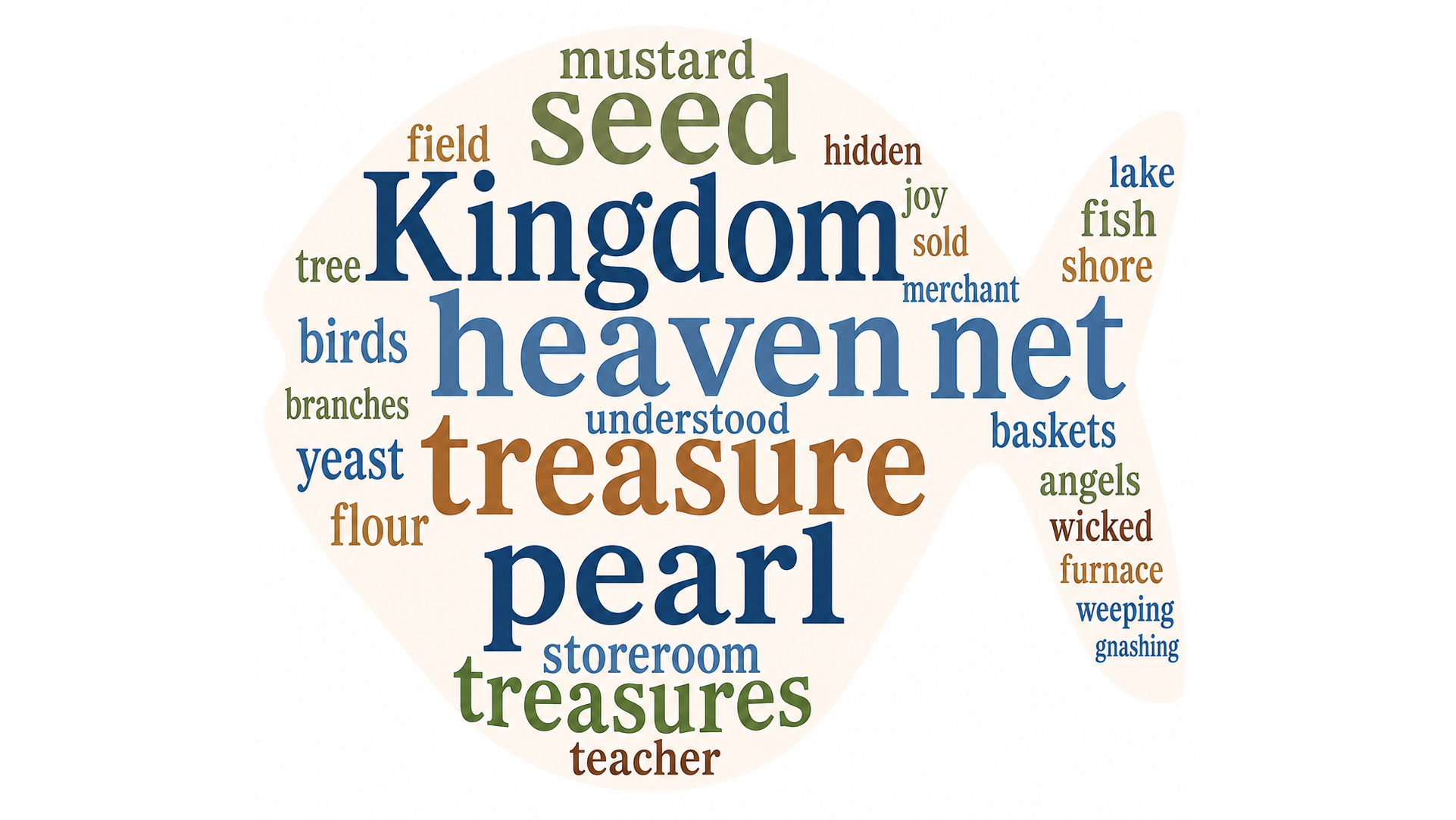
Matthew 13:31–33 and Matthew 13:44–52 describe the kingdom of heaven through ordinary things: a mustard seed, yeast, buried treasure, a valuable pearl, a fishing net, and a household storeroom. None of these images begins with public power or religious spectacle. Jesus points instead to things that are small, hidden, common, and easily overlooked. Through them, He shows that God’s kingdom often works beneath the surface before its full effect can be seen.
The mustard seed begins small but grows beyond what anyone would expect. Yeast disappears into the flour, yet it changes the whole batch. Treasure remains hidden until someone recognizes its value. A merchant searches until he finds the pearl worth everything he owns. A fishing net gathers every kind of fish before the final separation. Each parable reveals something different about God’s reign.
These parables would have encouraged disciples who wondered why Jesus’ ministry did not look like the political kingdom many expected. Rome still ruled. Religious leaders still resisted Him. Evil had not disappeared. Jesus’ followers remained a small and unimpressive group. Yet Jesus assured them that God’s kingdom had already begun and that nothing could prevent its growth or final victory (France).
The kingdom may begin quietly, but it will not remain small. It may be hidden, but it is not inactive. It is worth more than everything we possess, and it calls for a response. God’s grace invites us into the kingdom freely, but receiving that grace changes what we value, how we live, and what we are willing to release.
Origin and Name
The Gospel takes its name from Matthew, also known as Levi, a tax collector
who became one of Jesus’ twelve disciples. That matters because Matthew’s own
calling reflects one of the Gospel’s central convictions: Jesus brings grace to
people others have written off. A tax collector becoming a disciple and witness
fits the larger story of a Messiah who calls sinners, heals outsiders, and
forms a new people by mercy (France).
Authorship
Early Christian tradition connects this Gospel with Matthew the apostle. The
Gospel itself does not name its author, but it shows deep knowledge of Jewish
Scripture, careful theological structure, and concern for the life and teaching
of the Church. It presents Jesus as the fulfillment of Israel’s story and the
authoritative teacher of God’s people (Keener).
Date and Setting
Matthew was likely written between AD 70 and 90, after the destruction of
the Jerusalem temple. Jewish and Christian communities were wrestling with
identity, authority, worship, and faithfulness in a changed world. Matthew
speaks into that setting by showing that Jesus is not a break from God’s
promises to Israel but their fulfillment (Davies and Allison).
Purpose and Themes
Matthew presents Jesus as Messiah, Son of David, Son of Abraham, Son of God,
and Immanuel. Major themes include fulfillment of Scripture, the kingdom of
heaven, righteousness shaped by mercy, discipleship, judgment, mission, and the
presence of Christ with His people. Matthew never separates grace from
obedience. Jesus calls people into mercy, forgiveness, transformation, and
faithful living.
Structure
Matthew weaves narrative and teaching together. The Gospel includes five
major teaching sections, often seen as echoing the five books of Moses. Jesus
appears as the greater teacher who fulfills and rightly interprets God’s will.
The Gospel moves from Jesus’ birth and identity, through His ministry and
teaching, into His suffering, death, resurrection, and final commissioning of
the disciples.
Significance
Matthew bridges the story of Israel and the mission of the Church. It shows
that God’s covenant promises continue through Jesus and now move outward to all
nations. The final scene in Matthew 28 does not close the story as much as it
opens the Church’s mission.
Matthew 13 follows growing opposition to Jesus. Religious leaders question His authority, accuse Him of working through evil power, and demand a sign. Even members of His own family struggle to understand His ministry. Jesus responds by teaching in parables.
The parables explain why the kingdom does not look as people expected. God’s reign has arrived, but not through military conquest or political force. It begins like seed scattered in soil. Its growth can be resisted, delayed, or hidden, but it cannot be defeated.
The parable of the sower explains that the message of the kingdom receives different responses. The wheat and weeds show that good and evil will exist together until the final judgment. The mustard seed and yeast emphasize growth and transformation. The treasure and pearl reveal the kingdom’s unmatched value. The net points toward final accountability. The householder describes disciples who understand Jesus’ teaching and faithfully share it with others.
These images also connect with the wider biblical story. Ezekiel and Daniel use the picture of a great tree where birds find shelter to describe a kingdom extending its influence over many peoples (Ezekiel 17:22–24; Daniel 4:10–12). Jesus uses similar language to show that God’s kingdom will grow far beyond its small beginning and offer shelter to people from every nation (Keener).
John Wesley would have recognized prevenient grace in the hidden work of the mustard seed and yeast. God’s grace is active before we understand it, seek it, or know how to name it. Like yeast working through dough, grace moves within the human heart, awakening us to God and preparing us to respond.
The seed’s growth also reflects sanctifying grace. Spiritual growth usually does not happen all at once. God patiently shapes us through prayer, Scripture, worship, Communion, service, Christian fellowship, and acts of mercy. These practices do not earn grace. They place us where we can receive the grace God is already giving.
Wesley taught that grace restores what sin has damaged. God’s goal is not merely to forgive us while leaving us unchanged. Grace renews us in love for God and neighbor. Like yeast working through the whole batch, sanctifying grace reaches into every part of life, including our relationships, habits, speech, priorities, and use of money (Collins).
The treasure and pearl also reflect the Wesleyan understanding of wholehearted discipleship. Salvation is freely given, but following Jesus calls for our full response. We do not purchase the kingdom with sacrifice. We release lesser things because we have found something of greater worth.
Christian perfection, as Wesley understood it, does not mean freedom from mistakes or limitations. It means a heart increasingly filled with love for God and others. The kingdom changes what we treasure until love becomes the center of our lives.
Matthew 13:31–32, The Mustard Seed
Jesus compares the kingdom of heaven to a mustard seed planted in a field. The mustard seed was commonly used as an example of something very small. Jesus’ point is not to make a scientific statement about the smallest seed in existence. He is using familiar language to emphasize the contrast between a small beginning and surprising growth (France).
Jesus’ ministry appeared small when compared with Rome, the temple system, and the political hopes surrounding the Messiah. He traveled through Galilean villages with a small group of disciples. He owned no army, palace, or public office. Yet God’s kingdom was present in Him.
The seed becomes a large plant where birds can rest in its branches. This image suggests that the kingdom will grow beyond its Jewish beginning and welcome people from many nations. God’s purpose has always been larger than one community, culture, or nation. The promise given to Abraham was that all peoples would be blessed through him, and Jesus carries that promise forward.
The parable encourages patience. We often measure ministry by immediate results, public attention, attendance, or visible success. Jesus reminds us that God can use small acts of faithfulness. A prayer, a conversation, a meal, an invitation, or a quiet act of mercy may become part of something much larger than we can see.
Small does not mean unimportant. Hidden does not mean forgotten. God brings growth from seeds planted in faith.
Matthew 13:33, The Yeast
Jesus next compares the kingdom to yeast that a woman mixes into a large amount of flour. The yeast becomes invisible once it enters the dough, but its effect eventually reaches the whole batch.
Yeast sometimes represents corruption in Scripture, but here Jesus uses it positively. The meaning of an image depends on its setting. In this parable, yeast represents the quiet but powerful influence of God’s kingdom (Davies and Allison).
The amount of flour is large enough to feed many people. This suggests abundance. The kingdom’s influence will spread farther than the disciples imagine. God’s grace does not remain contained within one person or one congregation. Changed lives affect families, churches, communities, and future generations.
The parable also shows that transformation often begins within. God changes hearts, desires, attitudes, and values. That inner work eventually becomes visible through mercy, justice, forgiveness, generosity, and love.
The kingdom does not force change from the outside. It transforms people from within.
Matthew 13:44, The Treasure Hidden in a Field
In the ancient world, people sometimes buried valuables to protect them from theft, war, or political instability. Without modern banks, buried treasure might remain hidden if the owner died, fled, or could not return.
The man in the parable unexpectedly discovers treasure in a field. He hides it again and joyfully sells everything to purchase the field. The main point is not the legal or ethical question of finding buried property. Jesus focuses on the man’s recognition of the treasure’s value and the joy that shapes his response (Hagner).
The kingdom is worth more than everything else he owns. His sacrifice is real, but joy stands at the center of the story. He does not sell everything because someone threatens him. He does it because he knows what he has found.
Following Jesus can require us to release possessions, ambitions, resentments, habits, or relationships that keep us from faithful discipleship. Yet Christian surrender is not a gloomy loss. When we recognize the love of God revealed in Christ, we discover a treasure greater than anything we release.
The kingdom cannot be earned or bought. It is received by grace. The man’s actions show the complete reordering of life that follows when someone understands the kingdom’s worth.
Matthew 13:45–46, The Pearl of Great Value
The treasure is found unexpectedly, but the merchant is actively searching. He understands pearls and knows value when he sees it. When he finds one pearl of great worth, he sells everything to possess it.
The two parables show that people encounter Christ in different ways. Some seem to stumble upon faith while they are not searching. Others spend years asking questions, studying, praying, and longing for truth. God’s grace can meet both.
The pearl represents the unmatched worth of God’s kingdom. The merchant does not add the pearl to an existing collection. Finding it changes the value of everything else. In the same way, Jesus cannot be treated as one interest among many. He becomes the center around which life is reordered.
The parable asks what we consider valuable. Our calendars, spending, attention, worries, and ambitions often reveal our true treasures. Jesus invites us to recognize that life with God is worth more than status, comfort, control, or approval.
Matthew 13:47–50, The Net
Jesus compares the kingdom to a large fishing net cast into the lake. The net gathers fish of every kind. Once it is full, the fishermen bring it ashore and separate the good fish from those that cannot be used.
The net probably refers to a dragnet stretched between boats or pulled toward shore. It gathered everything in its path. The fishermen did not separate the fish while the net remained in the water. Sorting came at the end.
Like the parable of the wheat and weeds, the net warns against trying to make final judgments before God’s appointed time. The visible community of faith includes people at different stages of belief, growth, struggle, and commitment. The Church is called to proclaim the gospel, make disciples, offer grace, and practice accountability. It is not called to take God’s place as final judge.
The parable also makes clear that judgment is real. God’s grace is not indifference toward sin. Grace calls us to repentance because sin destroys what God loves. The warning about judgment is not given to satisfy curiosity about others. It calls each listener to examine his or her own response to Jesus.
God desires salvation, not destruction. Christ came to seek and save the lost. Yet love does not remove human freedom or make our response meaningless. The kingdom is freely offered, but it must be received.
Matthew 13:51, Understanding and Obedience
Jesus asks the disciples, “Have you understood all these things?” They answer, “Yes.”
Their answer probably expresses sincere but incomplete understanding. The disciples understand something, but later events show that they still have much to learn. They will misunderstand Jesus’ suffering, argue about greatness, abandon Him during His arrest, and struggle to believe the resurrection.
Jesus does not reject them because their understanding is incomplete. He continues teaching and forming them. Discipleship does not require perfect knowledge before we begin. It requires a willingness to listen, follow, and keep learning.
Understanding a parable means more than explaining it correctly. Biblical understanding includes obedience. To understand the kingdom is to allow its truth to shape how we live.
Matthew 13:52, Treasures New and Old
Jesus compares a teacher of the law who has become a disciple of the kingdom to the owner of a house who brings out new treasures as well as old ones.
The old treasures include Israel’s Scriptures, promises, laws, wisdom, and prophetic hopes. The new treasures are the ways those promises are fulfilled and clarified through Jesus. Jesus does not discard the Old Testament. He brings its purpose into clearer view (France).
A faithful Christian teacher values both. We do not abandon the Old Testament, nor do we interpret it apart from Christ. Jesus gives us the clearest picture of God’s character and teaches us how Scripture’s story reaches its fulfillment.
The householder also represents the responsibility of disciples. Those who receive the treasures of the kingdom are called to share them. We are not given truth merely for private enjoyment. We bring it out for the sake of others.
These parables address a common objection to Christian faith: If God’s kingdom has come, why does the world still contain evil, injustice, suffering, and unbelief?
Jesus does not deny the continued presence of evil. He explains that the kingdom begins within history before its final completion. It grows like a seed and works like yeast. The kingdom is already present wherever Christ’s authority is received, sins are forgiven, people are reconciled, the hungry are fed, the forgotten are welcomed, and love overcomes hatred. Yet the kingdom will not be complete until Christ returns.
This already-and-not-yet understanding helps explain why Christians can affirm God’s reign while still grieving the world’s brokenness. The presence of suffering does not mean God is absent. The mustard seed reminds us that beginnings can be small. The yeast reminds us that change can be hidden. The net reminds us that history is moving toward accountability and restoration.
The parables also make sense of the human search for meaning. People often sacrifice comfort, time, and possessions for what they believe is valuable. Jesus asks whether anything could be more valuable than reconciliation with God, freedom from sin, eternal life, and participation in God’s redeeming work.
Christian faith does not claim that sacrifice earns salvation. It claims that encountering Christ reveals a value so great that every other loyalty must be reconsidered.
These parables invite us to trust God’s work even when we cannot yet see the result. Churches may feel small. Ministries may grow slowly. Prayers may seem unanswered. Acts of kindness may appear unnoticed. Yet the kingdom often begins in ways the world considers insignificant.
We are called to plant seeds faithfully and trust God with the growth. We teach children, welcome strangers, forgive those who have hurt us, feed hungry neighbors, visit lonely people, pray for the suffering, and speak about Christ. We may not see what God does through those actions, but nothing offered in love is wasted.
The yeast challenges us to allow grace into every part of life. Faith cannot remain limited to Sunday worship. The kingdom must shape our homes, work, relationships, politics, finances, conversations, and treatment of people who differ from us.
The treasure and pearl ask us to examine what we value. Jesus offers a life grounded in the love of God, a love so strong that He gave Himself for us while we were still sinners. Grace is free, but it is not shallow. It changes what we pursue and what we are willing to release.
The net reminds us that our choices matter. We cannot save ourselves, but we can respond to the grace God gives. The proper response to judgment is not fear-driven religion or condemnation of others. It is repentance, trust in Christ, and a life increasingly shaped by love.
God’s kingdom may look small, but it is growing. It may be hidden, but it is working. It is worth everything, and through Christ, it is offered to everyone.
Ezekiel
17:22–24
Daniel 4:10–12
Luke 13:18–21
Luke 14:25–33
Philippians 3:7–11
Colossians 1:13–14
2 Peter 3:8–9
Revelation 21:1–5
