January 28, 2026
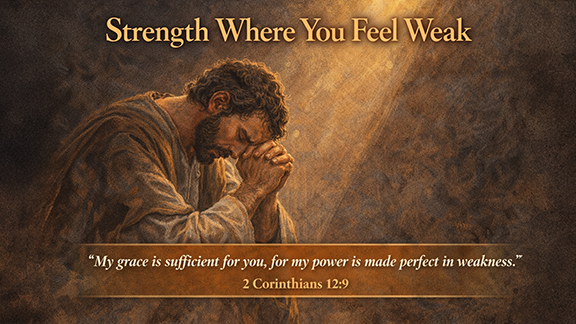
Paul shares a deeply personal moment of prayer in 2 Corinthians 12:9-10, asking God to remove something that causes him pain and limitation. Instead of taking it away, God assures Paul that grace will be sufficient and that God’s power is most visible in weakness. Rather than eliminating struggle, God reframes it as a place where divine presence and sustaining strength are revealed.
Devotional: Most of us spend a lot of energy trying to hide our weaknesses. We learn early which parts of ourselves feel acceptable and which parts should be kept quiet. We compensate, overfunction, and push through, hoping that if we’re strong enough, capable enough, or faithful enough, the fragile places won’t matter so much.
Paul doesn’t do that here. He names his weakness plainly and brings it directly to God. He doesn’t spiritualize it or pretend it’s fine. He asks for it to be taken away. That matters. Faith doesn’t mean pretending something doesn’t hurt. It means trusting God enough to speak honestly about it.
God’s response is not what Paul hoped for. The weakness remains. The struggle continues. But something else is given in its place. Grace. Not a solution, not an explanation, but presence. “My grace is sufficient for you.”
That word sufficient can feel frustrating at first. We want resolution. We want relief. We want strength that looks like control. But Paul discovers something unexpected. The weakness he wanted gone becomes the place where God feels closest. The place where he no longer has to rely on himself.
There is a quiet relief in that realization. The pressure to be strong all the time begins to loosen. The need to perform faithfulness gives way to something gentler. Paul doesn’t suddenly enjoy weakness, but he stops seeing it as evidence that God is absent. Instead, it becomes a place where God is deeply present.
This passage feels personal because most of us carry something we wish would change. A limitation. A fear. A wound that never fully heals. We may believe that once it’s gone, then we’ll be free to follow Jesus fully. Paul’s experience suggests something different. Sometimes discipleship isn’t about having fewer weaknesses, but about learning where to lean.
Christ is revealed here not as someone who demands constant strength, but as someone who meets us where strength runs out. He doesn’t wait for us to be impressive. He stays with us when we feel exposed and unsure.
If you’ve been measuring your faith by how well you hold it together, this passage offers permission to rest. Grace does not require you to be stronger than you are. It meets you exactly where you are and holds you there.
Action: Today, notice one place where you usually feel inadequate or tempted to hide. Instead of trying to fix it or push past it, acknowledge it honestly before God. Let that place become a point of connection rather than shame.
Prayer: God, we bring You the parts of our lives that feel fragile and unfinished. Thank You for meeting us there instead of turning away. Help us trust that Your grace is enough to hold what we cannot change. Teach us to rely on You when our own strength falls short. In Jesus’ name, we pray. Amen.
Thought for the Day: God’s grace meets us where strength runs out.
Paul asked God to take his weakness away, but God met him in it instead. This devotional reflects on what it means to stop hiding our fragile places and trust that grace is enough to hold us when strength feels thin.