
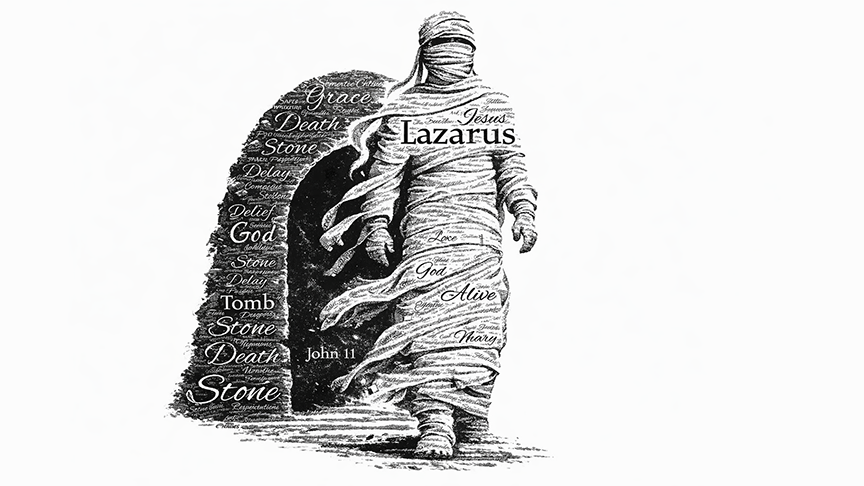
John 11:1–45 meets us in a place we know well, the place where grief has already entered the room and faith feels unsteady. Lazarus is sick, and two sisters send word to Jesus, but Jesus does not come right away. That delay sits at the heart of this passage. It is uncomfortable because it presses on the question most believers ask at some point: Where is God when the people we love are hurting? John does not rush past that tension. He lets us feel it. He lets Mary and Martha speak honestly. He lets the mourners weep. He lets Jesus Himself weep. This is not a detached miracle story. It is a deeply human account of loss, confusion, and love.
John makes it clear from the beginning that this story is about more than one man’s illness. Jesus says Lazarus’s sickness will not end in death but will be used for God’s glory so that the Son of God may be glorified through it. That does not mean suffering is good or that grief is brushed aside. It means death does not get the last word. In John’s Gospel, signs always point beyond themselves. They reveal who Jesus is. Here the raising of Lazarus reveals Jesus not simply as a healer, but as the resurrection and the life, the One in whom God’s life breaks into a world ruled by decay and loss (Carson).
This passage also stands at a turning point in John’s Gospel. The public ministry of Jesus is moving toward the cross. The raising of Lazarus becomes the sign that brings belief for many and hardens opposition in others. In other words, life for Lazarus will hasten death for Jesus. John wants us to see that clearly. The One who calls Lazarus out of the tomb will soon walk toward His own. Love is not abstract here. It is costly. Jesus enters the sorrow of this family knowing full well that this act of power will intensify the path to Calvary (Köstenberger).
There is also something deeply personal in the way John tells this story. Martha speaks theology. Mary brings tears. The mourners bring lament. Jesus brings both truth and compassion. He does not offer a lecture before He offers Himself. He does not dismiss sorrow with neat religious phrases. He stands in front of a grave and weeps. That matters. The God we meet in Jesus is not unmoved by human pain. He is not standing at a distance with folded arms. He steps into grief and then speaks life into the place that seemed sealed shut (O’Day).
Origin and Name
The Gospel takes its name from John, traditionally identified as John the son of Zebedee, one of Jesus’ twelve disciples. He was part of Jesus’ inner circle and witnessed key moments such as the Transfiguration and crucifixion. The Gospel reflects deep personal reflection on Jesus’ identity and mission (Keener).
Authorship
Early church tradition attributes the Gospel to the apostle John. Many scholars recognize that the final form likely reflects both John’s eyewitness testimony and the theological reflection of a community shaped by his teaching. The voice remains consistent with someone closely connected to Jesus’ ministry (Kostenberger).
Date and Setting
John was likely written near the end of the first century, often dated
around AD 85–95. It reflects a context in which the church was living after the
resurrection and wrestling with opposition, identity, and belief. The Gospel
speaks into a setting where followers of Jesus needed both assurance and
clarity about who He is (Burge).
Purpose and Themes
John states his purpose plainly, that readers may believe Jesus is the
Messiah, the Son of God, and that by believing they may have life in His name.
Major themes include belief and unbelief, life, light, glory, witness, love,
and Jesus’ unity with the Father. John’s Gospel presents Jesus not only as
teacher and miracle worker but as the incarnate Word through whom God makes
Himself known (O’Day).
Structure
The Gospel moves through signs and conversations that reveal Jesus’ identity, followed by His passion, resurrection, and post-resurrection appearances. Personal encounters, like Nicodemus here, carry theological depth.
Significance
John presents Jesus not only as Messiah but as God’s self-revelation. The Gospel emphasizes relationship with God as the center of salvation.
John 11:1–45 is the climactic sign in the first major section of the Gospel. Earlier signs have shown Jesus turning water into wine, healing the sick, feeding the hungry, and giving sight to the blind. Now He confronts death itself. This is the sign that gathers together many of John’s major themes, glory, belief, love, life, and conflict. It prepares the reader for the cross by showing that Jesus has power over the grave even as He moves closer to His own death (Carson).
Within the wider biblical story, this passage speaks into the long human ache caused by death. From Genesis onward, death is the shadow that falls across human life because of sin and the brokenness of creation. Prophets spoke of a day when God would swallow up death forever and wipe tears from all faces. In John 11, that future hope stands in front of a tomb and calls a dead man by name. Jesus does not simply talk about resurrection as a doctrine to be believed someday. He embodies it in the present. He is the life of the age to come breaking into the sorrow of the present age (Wright).
This story also echoes other moments in Scripture where God’s power meets human impossibility. Yet John gives it a sharper Christ-centered focus. The question is no longer simply what God can do, but who Jesus is. The raising of Lazarus is not just a miracle of compassion. It is a revelation. It tells us that in Jesus the promises of God are becoming flesh and blood reality.
John Wesley would have heard in this passage the deep music of grace at work before, within, and beyond human understanding. Martha and Mary send for Jesus before they know how the story will turn out. Their trust is imperfect but real. Grace is already at work in them, drawing them toward the One who alone can speak life into death. That fits well with Wesley’s understanding of prevenient grace. God is at work before we can fully name what we need or see what He is doing (Collins).
Wesley also emphasized that faith is not the absence of struggle. Martha’s confession is one of the strongest in the Gospel, yet it rises in the middle of heartbreak. She believes, but she still grieves. She trusts Jesus, but she still asks hard questions. That is a needed word for the Church. Holiness and trust do not require emotional denial. Grace makes room for tears, for lament, and for honest prayer. Jesus does not rebuke Martha and Mary for bringing Him their pain. He meets them in it.
From a Wesleyan lens, this passage also points toward sanctifying grace. Jesus does not leave people where He finds them. He calls Lazarus out, and then He tells the others to unbind him and let him go. That movement matters. New life is God’s gift, but the community also has work to do in helping remove what still clings to a person from the tomb. Wesley believed grace transforms, restores, and draws believers toward holy living in community. The church does not raise the dead, but it does help unwrap those Christ has made alive (Collins).
John 11:1–6, Love and Delay
The story opens with a crisis. Lazarus is sick, and the sisters send word to Jesus. John makes a point of saying Jesus loved Martha, Mary, and Lazarus. Then comes the part that feels jarring, when Jesus hears the news, He stays where He is two more days. John places love and delay side by side. That is hard for us because we often assume love means immediate intervention. But John insists that Jesus’ delay is not indifference. It is tied to a larger revelation of God’s glory that those around Him cannot yet see (Carson).
John 11:7–16, Walking Toward Danger
When Jesus finally decides to go to Judea, the disciples are alarmed because it is dangerous. They know opposition is building. Jesus speaks of walking in the day, a picture of moving in step with the Father’s will. He also speaks of Lazarus’s death in the language of sleep, showing His authority over what terrifies everyone else. Thomas, often remembered only for doubt later on, speaks here with grim courage, “Let us also go, that we may die with him.” Even in the disciples there is a mixture of faith, fear, and imperfect understanding (Burge).
John 11:17–27, Martha’s Confession
By the time Jesus arrives, Lazarus has been dead four days. John includes that detail to make the finality unmistakable. Martha goes out to meet Jesus and says what many grieving people have felt, “Lord, if you had been here, my brother would not have died.” That is not unbelief so much as wounded faith. She still calls Him Lord. She still believes God hears Him. Jesus responds by leading her deeper, from belief in a future resurrection to trust in Himself as the resurrection and the life. This is one of the great I Am sayings in John’s Gospel. Resurrection is not merely an event on God’s calendar. It is bound up in the person of Jesus Himself (O’Day).
Martha’s confession, “I believe that you are the Messiah, the Son of God,” places her among the clearest witnesses in the Gospel. John shows us a woman speaking strong theology in a moment of personal sorrow. That is no small thing. Her faith does not erase grief, but it holds onto Jesus in the middle of it.
John 11:28–37, Mary’s Tears and Jesus’ Weeping
Mary comes to Jesus and says the same words Martha said, “Lord, if you had been here.” This shared sentence carries the weight of a house full of sorrow. Yet Mary responds differently. She falls at His feet, and the scene turns fully toward grief. The mourners are weeping. Mary is weeping. Jesus is deeply moved and troubled. Then John gives us the shortest verse in English translation and one of the most powerful in all of Scripture, “Jesus wept.”
This moment matters because it rules out any view of Jesus as cold or emotionally distant. He knows He is about to raise Lazarus, yet He still weeps. He does not treat death lightly because He is about to defeat it. He feels the pain it causes. Scholars debate the nuance of Jesus being deeply moved, but the sense is clear, He confronts the horror of death and the sorrow it brings with profound emotional force (Carson). The tears of Jesus show the heart of God toward human suffering.
John 11:38–44, Come Out
At the tomb, Jesus again is deeply moved. The stone is still in place. Martha protests because of the odor, another reminder that Lazarus is truly dead. Jesus tells her to remember His promise that she will see the glory of God. Then He prays aloud, not because He needs the Father to hear Him, but so those standing around may believe the Father sent Him. The miracle that follows is stunning in its simplicity and authority. Jesus cries out, “Lazarus, come out!” and the dead man comes out, still wrapped in grave clothes.
The command is personal and powerful. Jesus calls Lazarus by name. Life answers His voice. Yet the story does not end with resurrection alone. Jesus tells the crowd, “Take off the grave clothes and let him go.” New life has arrived, but the signs of death still cling. The community is called to participate in the aftermath of grace, helping release Lazarus into the freedom Jesus has given him (Wright).
John 11:45, The Dividing Line of Faith
Many who see what Jesus has done believe in Him. That is John’s stated purpose. Yet the wider context will show that not everyone responds with faith. The same sign that awakens belief also intensifies resistance. Light reveals, but it also exposes. This miracle is not only about Lazarus. It is about the decision every witness must make concerning Jesus.
This passage speaks powerfully on both historical and philosophical levels. Historically, John places the story in concrete relationships and locations, Bethany, Judea, mourning customs, burial practices, and mounting conflict with authorities. The narrative has the texture of remembered experience rather than detached legend. Its emotional detail, especially the different voices of Martha and Mary, carries the ring of lived memory (Kostenberger).
Philosophically and theologically, the passage addresses one of the deepest human questions, what can be said in the face of death? Christianity does not answer that question with mere sentiment or vague optimism. It answers with a person. Jesus does not offer a theory before a tomb. He offers Himself as the resurrection and the life. That claim is either breathtakingly true or impossibly bold. John means for readers to face that claim honestly. The Christian hope is not built on denial of death’s reality but on Christ’s authority over it.
This text also speaks to the problem of divine delay. Why would Jesus wait? John does not give a tidy formula for every instance of suffering, but he does show that delay is not the same as absence and silence is not the same as indifference. The God revealed in Jesus may not act on our timetable, but He is neither careless nor cruel. He sees farther than we do and loves more deeply than we can measure.
John 11 speaks to anyone who has ever prayed and felt like heaven took too long to answer. It speaks to people standing in hospital rooms, funeral homes, broken marriages, empty bank accounts, and silent houses. Martha and Mary remind us that faith can speak honestly. We do not need polished words for Jesus. “Lord, if you had been here” is still a prayer. He can handle our grief, our confusion, and the ache of what we do not understand.
This passage also reminds us that Jesus is not only present in power but present in compassion. He weeps before He calls Lazarus out. That means when we suffer, we are not talking to a Savior who only diagnoses from a distance. We are talking to One who enters sorrow and stands with us in it. He is not hurried by panic, but neither is He untouched by pain.
And there is a word here for the church. Jesus still brings people out of tombs, not only literal death but the many forms of living death people carry, shame, addiction, despair, bitterness, isolation, fear. When He does, the community has a role. “Unbind him.” Help people leave the grave clothes behind. Walk with them. Pray for them. Make room for the slow work of freedom. Grace raises the dead, and grace also teaches the living how to walk in newness of life.
Isaiah 25:6–9
Ezekiel 37:1–14
John 5:24–29
John 6:39–40
Romans 8:11
1 Corinthians 15:20–26
Revelation 21:1–4
